Buying large cuts of meat and portioning them at home: the yield math that tells you if you actually saved
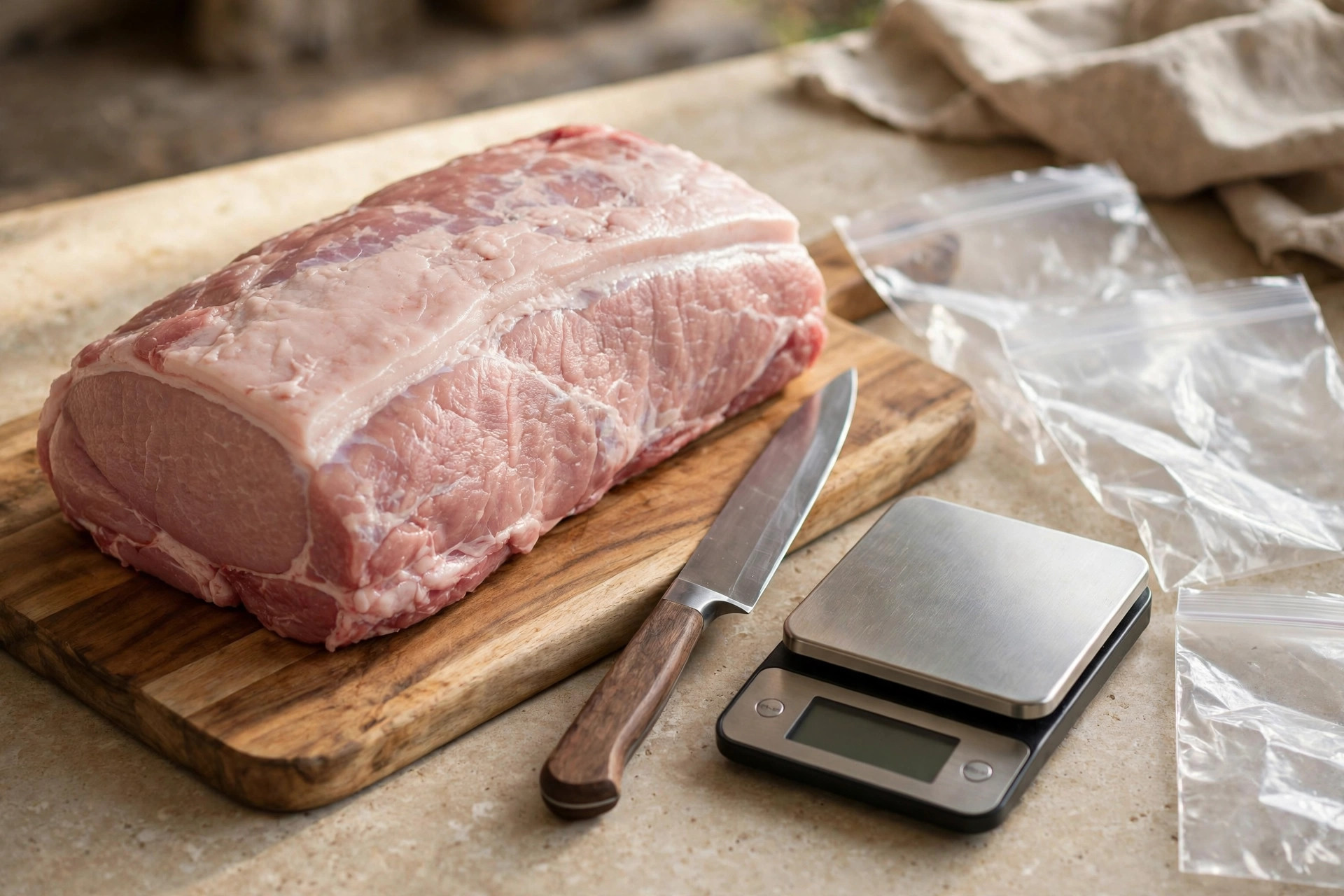
A whole pork loin sits in the case at a per-kilogram price well below the tray of chops beside it. The discount is real, and the reason is unromantic: the shop has not paid anyone to cut it. Butchers interviewed about bulk buying make exactly this point — unsliced primal cuts still in their vacuum packaging cost less because the labour has not been spent, and that saving is passed to whoever does the cutting at home. What the shelf tags never show is the second half of the maths. Part of that loin is trim, bone or liquid that will never be dinner. The honest comparison is not shelf price against shelf price. It is the price per usable kilogram, after the cutting is done — and that number takes about thirty seconds with a kitchen scale.
Why the shelf price per kilogram lies
Pre-cut meat is priced on the weight in the tray, and the tray contains almost nothing but dinner. A large cut is priced on its whole weight, including everything the home cook is about to remove. Two further leaks widen the gap. First, yield varies by cut: a boneless loin loses very little, while a bone-in piece gives up a meaningful share to bone. Second, the plan matters as much as the knife — a large cut portioned into meals the household actually cooks returns its full value, while one portioned optimistically and forgotten in the freezer returns nothing at all. Butchers make the same point from the other side of the counter: shops reuse trim and bones for ground meat, sausages and broth rather than throwing value away, and a home cook who lets every off-cut become rubbish is donating part of the discount back.
The yield calculation, worked with round numbers
The calculation is one division (original element: total-cost calculation):
Cost per usable kilogram = total price paid ÷ weight after trimming and portioning
Worked example, with round numbers chosen for clarity — not a price check and not a claim about any store's current prices. A large cut costs $30.00 and weighs 3.0 kg in its packaging: a shelf price of $10.00 per kilogram. After trimming and portioning, the scale shows 2.6 kg of meals and 0.4 kg of trim and packaging liquid. The true cost is $30.00 ÷ 2.6 = $11.54 per usable kilogram. Now the comparison is honest. If the pre-cut equivalent sells at $14.00 per kilogram, the large cut still wins clearly. If it sells at $11.00 per kilogram on a yellow-sticker special, the “discount” cut actually loses — before counting the half hour of cutting time. Run the same division with the household's real numbers: weigh the portions, not the packaging, and compare against the per-kilogram price of the cut that would otherwise have been bought. Two shopping trips of data are enough to learn which large cuts genuinely pay in a given store, and which are theatre.
What one large cut becomes: the cutting plan
A large cut earns its discount when every section has a named meal before the knife comes out. This plan reflects the cuts and uses named by the interviewed butchers (original element: comparison table).
| Large cut | Portions it becomes | Cooking notes from butcher interviews |
|---|---|---|
| Whole pork loin | Chops; a small roast; thin strips for stir-fry | Lean and quick-cooking; the easiest first large cut because there is no bone |
| Beef chuck | A pot roast; stew cubes; a portion for mince-style dishes | Named a versatile budget primal; tougher sections want low-and-slow cooking, and chuck can be transformed into mince-style mixtures |
| Beef brisket (for confident cooks) | One piece to smoke or braise whole; one to brine; one to braise and shred | The interviewed butcher's own example splits a brisket three ways — barbecue, corned-beef style, and shredded for pasta, tacos or dumpling filling |
| Whole chicken | Breasts; thighs and drumsticks; wings; carcass for stock | Named a solid cost-per-pound buy; the carcass is the broth the butchers refuse to waste |
| Bulk pack of ground meat | Flat meal-size freezer portions | No knife work at all: the entry-level version of the same idea |
Notice what the plan excludes: a whole or half animal. That is a different commitment — freezer capacity, a processor, months of eating — and it sits outside a grocery-budget guide. Large retail cuts are the version that fits a normal freezer and a normal week.
The portioning session: a food-safe procedure
Cutting raw meat at home is a food-safety task as much as a money task. The steps below follow Canadian guidance — Health Canada's basics are organised as clean, separate, cook and chill (original element: tested procedure).
- Set up before the meat comes out. Wash hands with warm soapy water, and wash and sanitise the board, knife and nearby surfaces. Lay out bags or wrap, a marker, and the kitchen scale. Raw meat, poultry and seafood stay separate from every other food throughout.
- Work in one sitting, and watch the clock. Bacteria grow quickly in the 4°C to 60°C danger zone, and food should be refrigerated or frozen within two hours. A retail-size cut portions in well under that; if the job is interrupted, the meat goes back in the fridge, not onto the counter.
- Cut to the plan, weighing as you go. Portion into the meals named in the cutting plan, weigh the finished portions for the yield calculation, and keep trim destined for stock or mince-style use in its own container — separate from waste.
- Package flat, label honestly. Portions go into freezer bags with the air pressed out, laid flat so they stack and thaw evenly. Every package gets the contents, the weight and the date. Flat, labelled portions are what make a freezer a system instead of an archaeology project.
- Chill on the right clock. Health Canada's storage chart, for a fridge at 4°C or lower and a freezer at −18°C or lower: fresh beef, pork, lamb and veal keep 2–4 days in the fridge and 8–12 months in the freezer; chicken and turkey 2–3 days and 6–12 months; ground meat and raw sausages only 1–2 days in the fridge and 2–3 months in the freezer. Canada Beef's chart agrees in shape — steaks, roasts and chops at 2–4 days / 8–12 months, stew meat and strips shorter in the freezer at 3–6 months. Anything not being eaten within the fridge window goes into the freezer the day it is portioned, not the day it expires.
- Clean down, then thaw safely later. Wash and sanitise everything the raw meat touched. When a portion comes back out, thaw it in the fridge, in the microwave, or in a sealed bag in cold water — never at room temperature — and cook microwave-thawed meat immediately.
What success looks like: every portion is labelled with contents, weight and date; the yield calculation is written down and beats the pre-cut price per usable kilogram; the fridge portions are scheduled inside their 2–4 day window; and the work surface is sanitised with the meat's total time out of refrigeration well under two hours.
When a large cut is a bad buy
Three situations erase the discount entirely. The yield test fails: heavy trim or bone pushes the cost per usable kilogram above a pre-cut special, which is common exactly when pre-cut meat is on a markdown — the two discounts compete, and only the division decides. The freezer test fails: a household that will not eat the portions inside their freezer life has bought future waste at a discount, and Canada Beef's guidance to keep the fridge below 4°C and leave room for cold air to circulate applies to the freezer's organisation too — a jammed freezer hides portions until they are found too late. And the knife test fails: an unfamiliar cut, portioned badly, yields awkward pieces nobody wants to cook. The butchers' advice for that case is to choose cuts the cook already understands and can picture in several meals — sirloin, chuck and skirt are named as forgiving, versatile starting points, and a whole loin asks for nothing more advanced than even slicing.
FAQ
How much trim is normal? It varies too much by cut and by how the piece was prepared to quote a single figure honestly — which is the entire reason for weighing at home. Two or three sessions give a household its own yield figures for the cuts it repeats, and those figures are the ones worth trusting.
Is a vacuum sealer required? No. Freezer bags with the air pressed out, laid flat, handle retail-size portions well within the freezer times in the storage charts. Air removal matters because it protects quality over months, not because the equipment is the point.
Can trim and bones really be used? Shops build ground meat, sausages and broth from them rather than discarding them. At home the realistic versions are a stock from bones and carcasses, and clean meat trim folded into a mince-style dish within its 1–2 day fridge window — or frozen the same day.
What is the easiest place to start? The bulk pack of ground meat: portion it flat in meal-size bags the day it comes home, inside its short fridge window, and the household gets the portioning habit — and the yield habit of weighing what was bought against what gets eaten — with no knife skills at all.